Paul Nelson Ulrich
Dr. DeathPaul Nelson Ulrich is the identity under which a physician becomes the prime suspect in Eldon Mate’s murder, but it is only one name in a trail that also includes Michael Ferris Burke and the aliases attached to Alex Delaware’s earlier guesses. His story is defined by that unstable identity and by the belated convergence of physical evidence: a hidden cache, surgical tools linked to the killing, and a shooting in Malibu that ends his presence in the investigation without resolving every question about his motive.
Identity and Background
Authorities identify Ulrich as a forty-year-old physician and report that he was licensed to practice in New York State under the name Michael Ferris Burke. The distinction between the name attached to the physician’s license and the name used in the murder investigation makes identity itself part of the case. A further name, Dr. L. Pasteur, appears on the rental for a Panorama City storage locker. The evidence establishes the names and their connections to Ulrich, though it does not explain when or why he adopted each one.
Alex Delaware’s later reflection gathers the aliases Rushton, Burke, and Ulrich into a single trail of mistaken identifications. In retrospect, Delaware recognizes how many of his guesses had been wrong; the sequence shows that the difficulty was not simply finding a suspect, but recognizing that apparently separate identities belonged to the same man. The narrative gives that recognition a cost: Delaware imagines Ulrich might have been amused by the errors, while also judging that instructing his pursuer in humility would have mattered little to him.
The Mulholland Kill Site
The road associated with the crime is no simple route from beginning to end. Mulholland stretches for more than thirty miles, from East Hollywood to the Pacific, and wilderness blocks passage at several points. The landscape makes access difficult, lending weight to the question of whether Ulrich chose the site with its isolation and obstructions in mind. The text raises that possibility without presenting it as a proven fact about his planning.
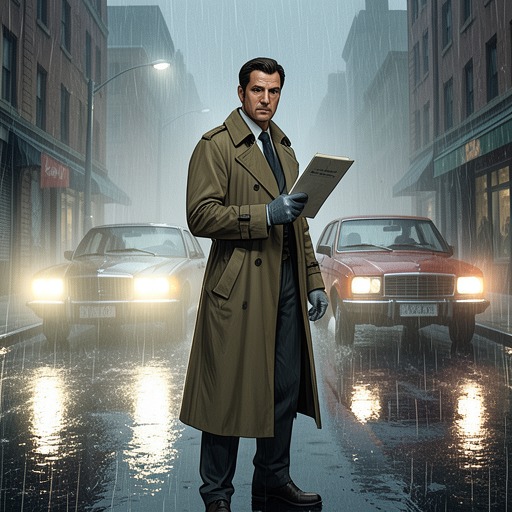
At the end of the search, the path opens onto an egg-shaped parking area bordered in part by large circular rocks. The rough stone edging appears to be an old attempt at landscaping, disrupted by the elements. Ulrich’s navy BMW is parked there beside Tanya Stratton’s copper-colored Saturn. The two vehicles place Ulrich and Stratton at the property, while the location’s secluded, difficult-to-reach character sharpens the contrast between an ordinary parking area and the violence that follows.
Shooting and Official Account
In Malibu, Ulrich is shot several times in what authorities describe as a police-involved shooting. The account presented afterward identifies him as the prime suspect in Mate’s murder, but says that the circumstances of the shooting remain under investigation. The available account therefore establishes both the fatal outcome and an important limit: the official report does not settle the circumstances in which he was shot.
The shooting is rendered through a stark image of accumulating wounds. After the first shot from behind, a red mark spreads across Ulrich’s chest; further shots leave additional red marks on his white shirt. He remains standing at first, with a leather bag still in his hand and his mustache obscuring his expression. From his position behind Ulrich, Milo Sturgis runs back to cover with his gun drawn, but has no one to shoot at; the shooter is above, in the pine growth on the ridge. The scene makes the attack visible while withholding an immediate target for Milo’s response, turning the surrounding terrain into a source of danger as well as concealment.
Evidence, Motive, and Narrative Significance
A month and a half after Mate’s killing, Milo has catalogued four cardboard cartons recovered from a Panorama City storage locker rented by Ulrich under the name Dr. L. Pasteur. A key found in Ulrich’s bedroom nightstand led investigators to the locker. The locker’s contents are described as beautifully organized, a concrete contrast with the unsettled identities surrounding its owner. By comparison, the house yielded nothing very interesting, and Tanya Stratton vacated the premises within days of the Malibu shooting.
Authorities report that evidence recovered at the shooting scene and elsewhere—including surgical tools believed to be the weapons used to kill Mate—indicates that Ulrich acted alone. That is the official conclusion represented in the report, not a motive: officials have put forward no reason for Mate’s slaying. They also suggest that Ulrich may have been mentally ill, presenting this as a possibility rather than a settled diagnosis. These qualifications matter. The case links Ulrich to the murder through physical evidence and a chain of names, yet the account does not supply a definitive explanation of why he killed Mate.
Ulrich’s narrative role is thus less a fully disclosed personal history than a gradual unmasking. The aliases, the locker key, the organized cartons, and the surgical tools build a path toward identification, while the unresolved motive and circumstances of the shooting keep that identification from becoming complete knowledge. Delaware’s admission of repeated error closes the gap between investigator and reader: the case’s answer emerges through correction, but even after Ulrich is named as the prime suspect, some of the story remains beyond reach.